Piran
Piran
A Venetian town perched on its peninsula, Piran combines medieval alleyways, ancient salt pans, and Adriatic swimming. A complete guide to discovering it.
Picturesque Mediterranean town, Piran captivates with its stunning Adriatic coastline harmonizing perfectly with the city's medieval architecture. An unmissable destination during a journey through Slovenia, this charming settlement promises a complete escape with its salt pans, historic and cultural monuments, typical beaches, and more. The cultural events held here will further enrich your travels on Slovenia's Piran lands.
A brief history
Etymologically, the town's name comes from the Greek "pyr," meaning fire. Indeed, in ancient times, a lighthouse was installed on the peninsula to serve as a landmark for ships wishing to enter the port of Aegidia (now called Koper).
The Romans founded the city under the name Piranum. Around the 3rd century, the Republic of Venice took control of the territory. Piran received its patrimonial heritage (the salt pans) and distinctive architecture during this Venetian era. The town later fell under Austrian control and became attached to Italy following World War I. After World War II, it was united with the Yugoslav Republic of Slovenia in 1954 until the country gained independence in 1991.
Piran, the most beautiful town on the Adriatic coast
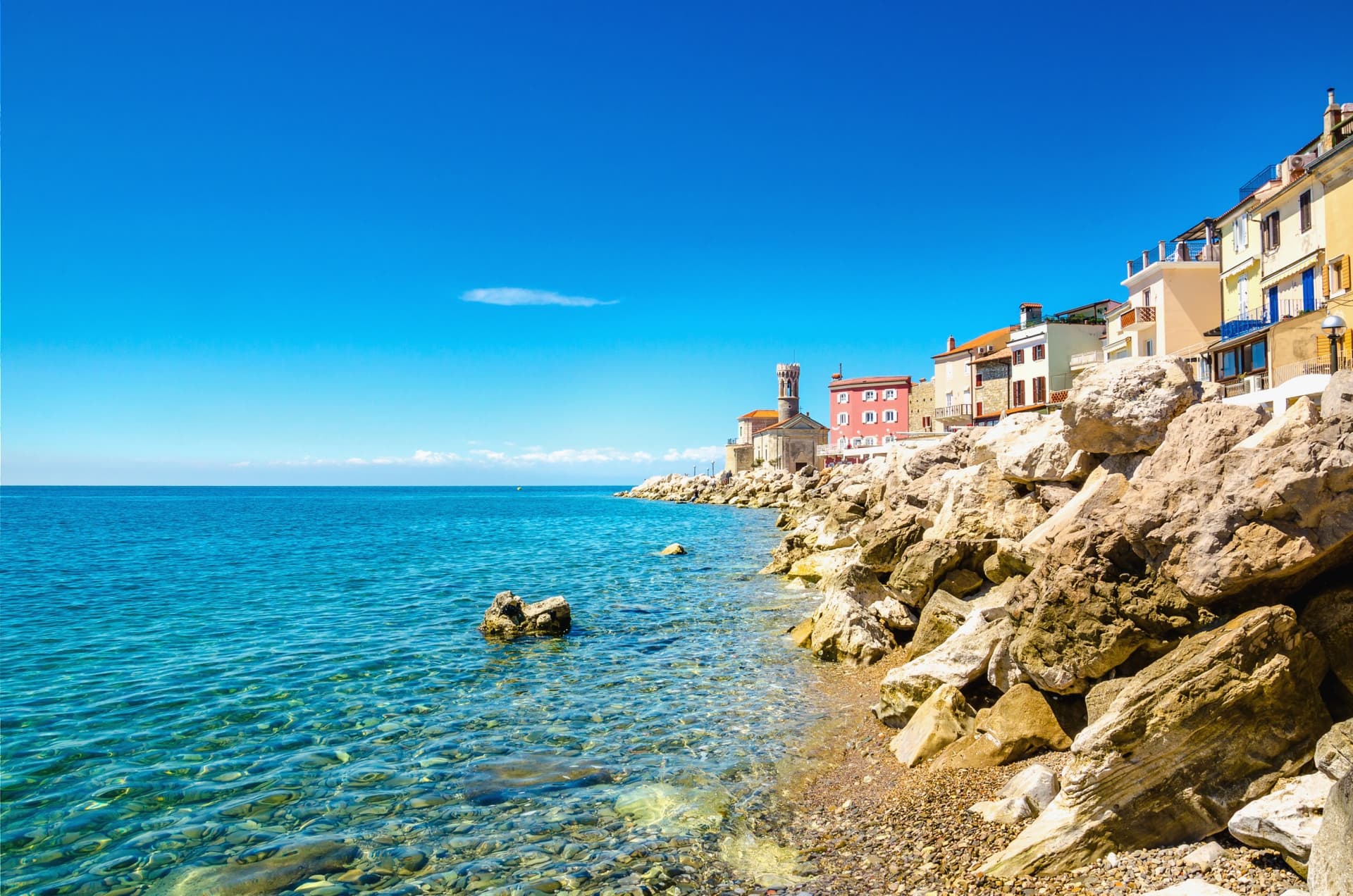
Charmingly nestled at the tip of a narrow peninsula, Piran sits at the southwestern edge of Slovenia. This former port city is wonderfully framed by the Adriatic Sea, making it a fashionable coastal destination highly prized by travelers. Beyond its medieval rampart remnants, it also showcases the jewels of Venetian Gothic architecture. For all these reasons, it has been designated a historic and cultural monument. At the sight of the harmonious marriage between the sea's blue, the ochre color of house rooftops, and the green of trees, it is undeniable that Piran is the most picturesque coastal town in Slovenia.
Situated on Slovenia's Littoral, Piran is surrounded by Croatia to the south, Italy to the north via the Gulf of Trieste, and the municipalities of Izola and Koper to the east. The municipality spans 44.6 km² and is home to 17,675 inhabitants.
Why Piran?
Beyond its magnificent medieval setting (streets and buildings) and natural landscape (sea and trees), the town of Piran is also known for its salt pans (Sečovlje and Strunjan), its beach resort and airport in Portorož, as well as its various festivals.
The Salt Pans of Piran
- An unmissable Piran attraction, the Sečovlje salt pans are located near the Croatian border. Exploited for over 700 years, they extend across an area of 7.5 km². Designated a "natural park" in 2001, the site is divided into two sections by the Drnica Canal: the northern part called Lera and the southern section named Fontanigge. The Lera basins continue to be worked today, while salt harvesting at Fontanigge was abandoned around 1960. At Lera, traditional medieval methods are still employed, though slightly modernized by the Austrians in 1904.
The salt harvest season depends on weather conditions, but as a guideline, we recommend the period between June and September. At Lera Park, there is a multimedia center with exhibits on salt production, a bar and souvenir shop. In the latter, you can purchase fleur de sel, fine salt, coarse salt, household linens, and more. Fontanigge, for its part, is ideal for walks to explore the ruins of the salt works.
On the northern side of the Sečovlje Salina natural park is nestled the outdoor spa center, Spa Lepa Vida Thalasso. Benefit from thalassotherapy treatments by enjoying the house's services: manual body massages, salt mud wraps, brine/mother liquor baths, sea salt scrubs.
- The Strunjan salt pans, unlike those of Sečovlje, are located midway between Izola and Piran, accessible by bus. The area where they are situated has also been designated a natural park for its protection. This site features a remarkable flysch cliff rising 80 meters above the sea.
The Portorož Beach Resort and its Airport
Portorož, near the Croatian border, is a major tourism hub on Slovenia's coast. Perhaps a bit too developed, this beach resort has no sand but remains very lively nonetheless. It attracts many tourists for its distinctive features: sunbathing lawns, pleasant bars, and seaside restaurants, among other offerings. There is something to satisfy visitors of all kinds and ages. Indeed, there are children's games and excellent ice cream to refresh and enhance your vacation.
Beyond the region's typical beach, Portorož is also home to the country's third international airport. It serves Slovenia's coast and cities in neighboring countries such as Italy and Croatia.
The Salt Workers' Festival and the Tartini Festival
Find Piran in celebration every April, the period when residents would descend into the salt marshes for the salt harvest (salt workers' season). They celebrate the Salt Workers' Festival with a variety of entertainment on Tartini Square.
The International Tartini Festival, for its part, takes place each summer and is dedicated to chamber music. The events Piran offers will enhance your stay in this special location.
What to see in Piran?
The Historic City Center, Maja Square
Piran is a town with tourism at its heart thanks to its numerous seaside restaurants and bars. Its charming alleyways are lined with Venetian-style houses displaying a magnificent variety of colors that enhance the landscape, especially on the main square. In the center of Maja Square, you'll find the large stone cistern in Baroque style that once collected rainwater.
Tartinijev Trg Square
In 1692, Italian violinist and composer Giuseppe Tartini was born in the famous Tartini House in Piran, which gave the city's central square its name. This square is characterized by an oval marble floor with Tartini's statue at its center. An unmissable feature of the town, Tartinijev Trg Square is beautifully surrounded by Venetian-inspired buildings in pastel tones. You'll also find the Church of St. Peter to the east and the Tartini House facing it. The town hall and the courthouse dominate the west side of the square. During your city visit, you can take a break in the local cafés and restaurants while enjoying the view from their balconies.
St. George's Cathedral
Come admire St. George's Cathedral, which majestically overlooks the town. It offers spectacular panoramic views from its Venetian campanile, the main point of interest at this attraction. Built in the early 17th century, it captivates with its magnificent ornamental paintings and interior decorations.
The Ramparts of Piran
Also an unmissable feature of Piran, these ramparts once ensured the town's protection during the medieval period. Nestled on the town's heights and very well preserved, they are truly worth visiting, as they offer breathtaking views over the peninsula and the Bay of Trieste.
Museums in Piran
We would mention the Sergej Masera Maritime Museum dedicated to the sea, located near the port in Gabrielli Palace, as well as the Underwater Diving Museum.
What to do in Piran?
Take a stroll along the seashore in Piran
Bordered by stone delimiting the sea, this place will help you forget your worries thanks to the soothing sea breeze that prevails here. Treat yourself to a lovely pedestrian walk, solo or with your loved one. Piran's waterfront is full of numerous restaurants for family gatherings.
Cycling on Parenzana
This Parenzana bike path connects Trieste in Italy to Poreč in Croatia, passing through Piran's salt pans. It spans 130 km, offering a bicycle ride along the route of an old abandoned railway line.
Hiking
Piran is full of hiking and equestrian trails. They interconnect Portorož, the famous beach resort, with other coastal towns, the two natural parks, and Istria's attractions.
Swimming in the Adriatic Sea
The beaches of Piran are quite distinctive. For a change of pace, opt for the rocky and concrete beaches of this Slovenian town to swim in the Mediterranean Sea. A concrete platform allows for sunbathing, which many enjoy. For those who want to swim, there is a staircase providing access to the water for a good dip. Northeast of town, you'll also find the Fiesa pebble beach, slightly rocky with limited sand.
Diving
Would you like to explore the depths of the Adriatic Sea? You've made an excellent choice in selecting Piran as your destination, as diving clubs on-site (Subnet Diving, Piran Divers) offer introductory courses. Experience it to add excitement to your stay in Slovenia.
When to visit Piran?
The best time to visit Piran would be between April and October when the beautiful Slovenian sun smiles upon you and warms you with temperatures ranging from 11 to 29°C. There can be some rain during this period, especially towards September and October.
Most visitors arrive in Ljubljana. From there, it takes 1.5 hours of driving to reach Piran. If you come from Trieste in Italy, the journey will only take 45 minutes. If you travel from Zagreb (Croatia) to Piran, plan on 2 hours of driving.
You can rent a car, as Motorway A1 is easily accessible. Several buses also connect Slovenian towns.
Want to discover this destination?
Our local advisors design your tailor-made trip.