Ljubljana and Central Region
Capital of 295,000 inhabitants nestled among rolling hills, designed by Plečnik, the perfect starting point for Idrija, Dolenjska and the Ljubljansko barje wetlands.
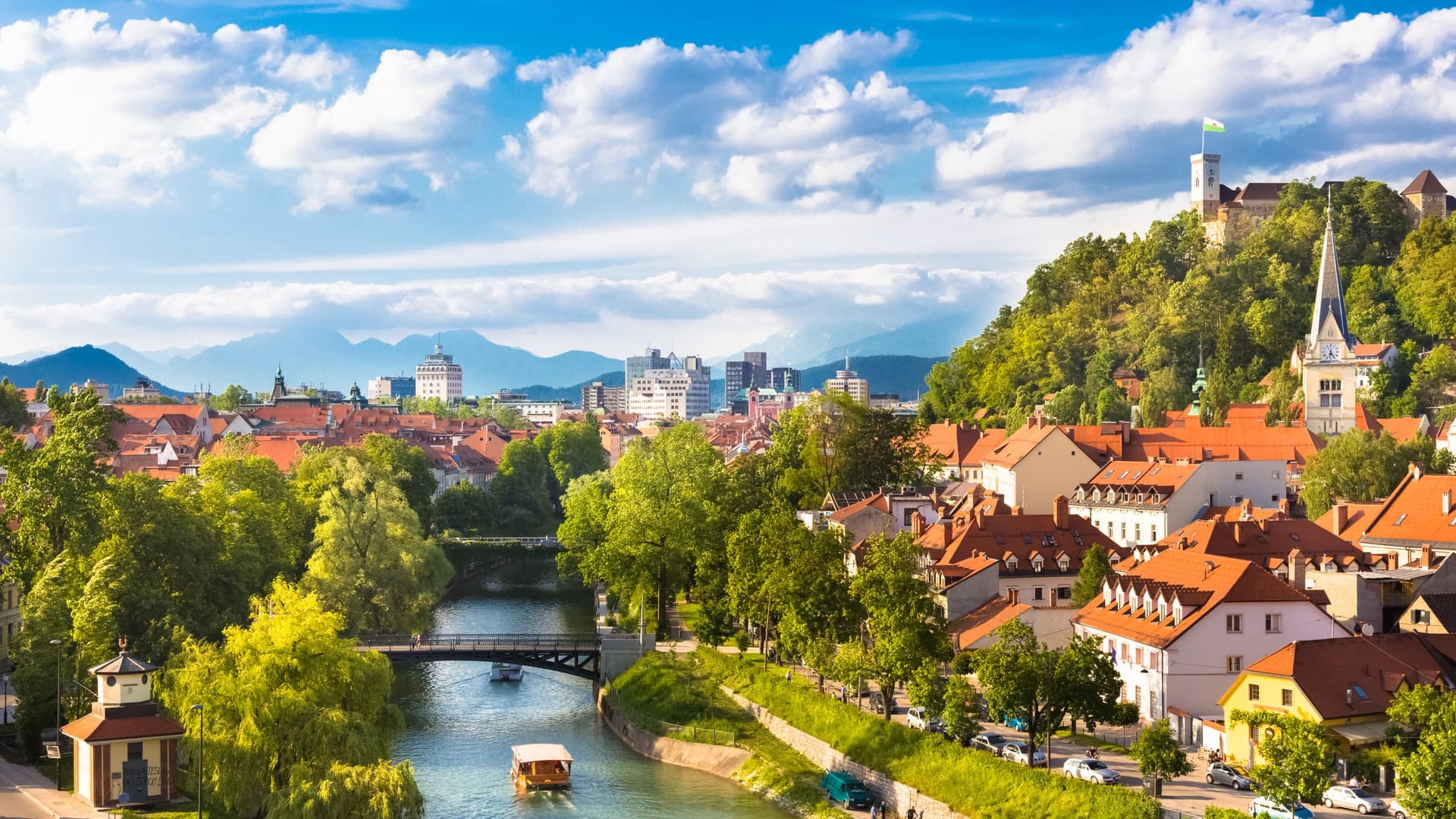
Ljubljana is home to 295,000 inhabitants, making it one of Europe's smallest capitals. The city revolves around the Ljubljanica, a narrow river crossed by the three Plečnik bridges (Tromostovje), the work of architect Jože Plečnik, who redesigned the centre in the interwar period. His signature is evident everywhere: the NUK national library, the covered market on the riverbanks, the Križanke colonnades. Our agency is located a ten-minute walk from the castle on the left bank, and we work daily with producers and hosts throughout the region.
Ljubljana's basin, ringed by wooded hills (Rožnik, Golovec, Šmarna gora), creates a unique microclimate: thick fog from October to December that often lifts above 600 metres elevation. This is worth knowing if you plan to venture toward the Alps in autumn, as the sky can be clear in Bled while the capital remains shrouded in grey. The climate is temperate continental: an average of 0°C in January, 22°C in July, with rainfall distributed throughout the year and a peak in June.
The historic centre is best explored on foot, from the Ljubljanica quays to Prešeren Square, through to the old town beneath the castle. The funicular ascends to the fortress in two minutes, offering panoramic views over orange-tiled roofs and the Kamnik Alps to the north. For dining, the central market on Vodnik Square operates Monday to Saturday mornings: producers from Sorško polje, cheesemakers from Dolenjska, buckwheat honey, charcuterie from Kranj. Friday noon brings Odprta kuhna (open kitchen) to the square from April to October. Signature dishes we introduce guests to include jota (cabbage, bean and potato soup), štruklji (rolled pastries filled with fresh cheese or walnuts), and potica for dessert.
Beyond the capital, the central region encompasses southern Dolenjska and part of Notranjska. Thirty minutes to the north-east, Renaissance Bogenšperk Castle houses the library of Johann Weichard von Valvasor, a 17th-century scholar who documented Carniola. The Sava Valley extends north toward Litija, a former mining centre, through a landscape of green hills dotted with Baroque churches. Further west, 75 minutes by road, the town of Idrija (UNESCO-listed) chronicles five centuries of mercury extraction: the open Antonijev rov galleries, the wooden Kamšt extraction machine, and the bobbin lace tradition that occupied miners' wives.
To the south, 40 minutes away, Ljubljana Marsh (Ljubljansko barje) is an alluvial plain where the world's oldest wooden wheel, dated around 5,200 BC, was discovered. Today it's a regional nature park, crisscrossed by cycling paths and trails through wetland meadows and isolated farms. Still to the south, Postojna Cave and Predjama Castle belong more properly to the Karst region, but are reached in 45 minutes from Ljubljana and are often combined in a day trip from the capital.
Ljubljana is not a museum city: it's a student capital (50,000 university enrolees), with a vibrant cultural scene centred on Metelkova, a former military barracks reimagined as a creative hub, and café culture that spills onto the riverbanks as soon as the weather improves. It's also the country's logistical hub: Jože Pučnik Airport is 25 km away, trains and buses depart to all regions, and no point in the territory is more than three-and-a-half hours by road.
Must-See
Old Town and Plečnik bridges. A walk through Tromostovje, the covered market and Prešeren Square, then take the funicular to the castle for views over the rooftops and the Kamnik Alps to the north.
Idrija Mercury Mine (UNESCO). Descend into the Antonijev rov gallery, opened in 1500, and visit the bobbin lace workshop. Allow a full day including lunch of žlikrofi, local potato-filled dumplings.
Friday's Odprta kuhna Market. April to October, Vodnik Square, around thirty Slovenian chefs set up open-air kitchens. Our go-to spot for tasting a dozen dishes in one lunch.
Ljubljansko barje Wetlands. Cycling through the alluvial plain south of the city, between the Iški morost birdwatching observatory and the farms of Bevke village. An archaeological pile-dwelling site inscribed on the UNESCO list.
Bogenšperk Castle and Sava Valley. Half-day in inner Dolenjska: Valvasor's library, hills at 600 metres, lunch in a Litija gostilna (traditional inn).
When to Visit
The best window for Ljubljana and the central region runs from April to end of June, then September to mid-October. In spring, temperatures climb from 15 to 22°C, terraces open after Easter and the Odprta kuhna market resumes in April. July and August are warm (28 to 32°C at peak, sometimes stormy in late afternoon) and the city partially empties: convenient for sightseeing without crowds, less pleasant for driving in the heat. Autumn offers the finest light and richest table (game, chestnuts, Dolenjska wines), but watch for basin fog in November, which can persist for a week.
December merits a visit for Christmas markets along the Ljubljanica, in a contained atmosphere (the city remains human-scale). January and February are cold (0 to 5°C, possible snow for one to two weeks) and quiet, except when combined with skiing in the Julian Alps. Idrija and the Sava Valley, slightly higher in altitude, can receive snow from late November while the capital stays above freezing.
Practical Advice
We recommend 2 to 3 nights in Ljubljana to properly grasp the city and make an excursion to the region (Idrija, Bogenšperk, or wetlands and Postojna). Three nights allow two full excursion days without moving luggage. Jože Pučnik Airport (Brnik) is 25 km to the north, connected by shuttle in 45 minutes or taxi in 30. The main train station serves Vienna, Zagreb, Trieste and Munich by direct train.
Ljubljana functions as the logical starting point for a Slovenian circuit: the Julian Alps (Bled, Bohinj, Triglav) are 1 to 1.5 hours to the north-west, the Soča Valley 2 hours via Vršič Pass or tunnel, the Karst and Istrian coast 1 to 1.75 hours to the south-west, Štajerska (Maribor, Ptuj) 1.5 to 2 hours to the east. Our most fluid itinerary: 2 nights in Ljubljana early in your stay for acclimatisation and culture, then a loop clockwise or counter-clockwise depending on season. The city suits all profiles, including families with young children (pedestrian centre, short distances) and contemplative travellers who will appreciate the unhurried pace of the riverbanks and cafés. Quality accommodation ranges from guesthouses in the old town to contemporary design hotels, with no mass budget equivalent.