Peričnik Waterfall
Peričnik Waterfall
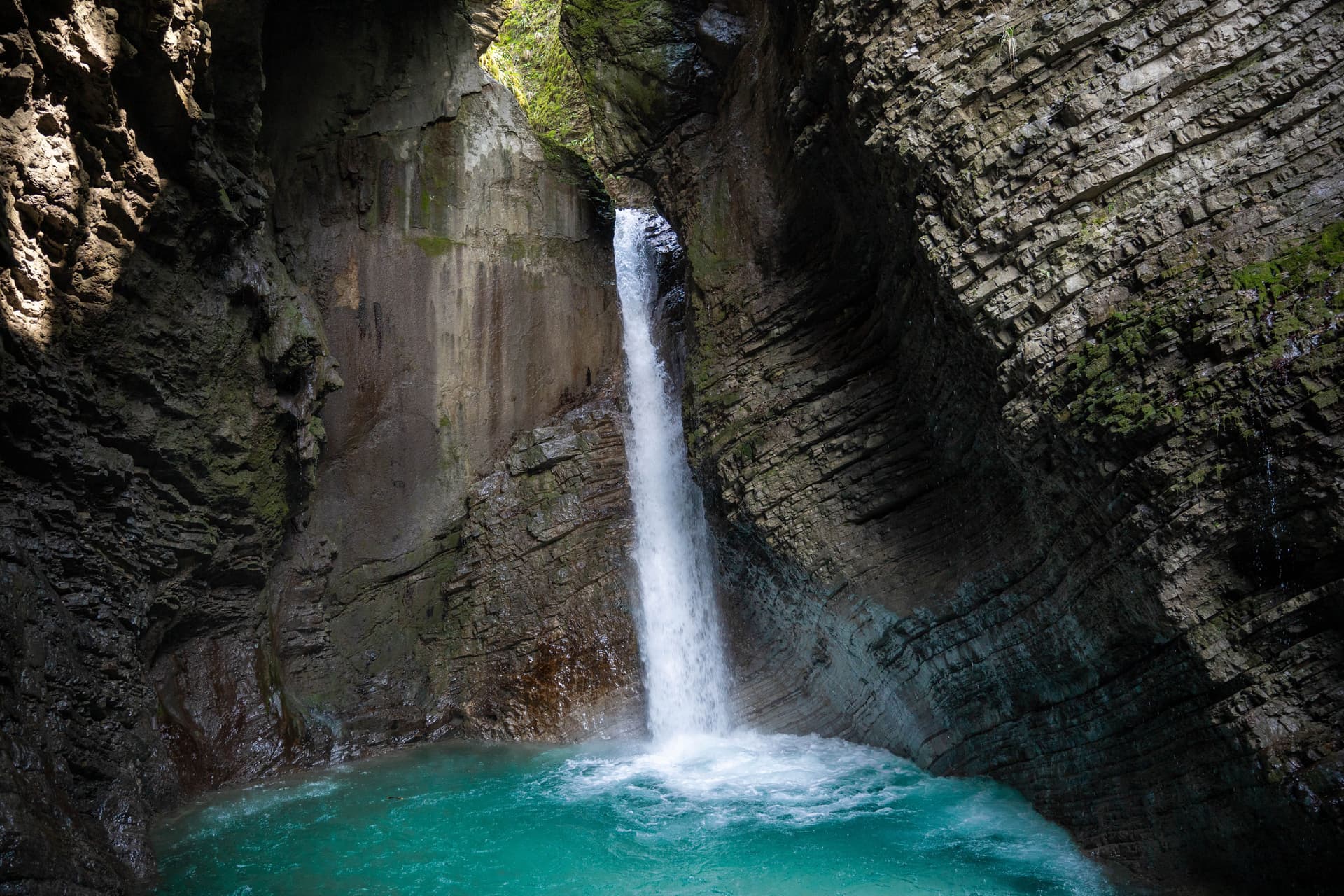
Peričnik Waterfall, nestled in Vrata Valley, offers a rare experience: a path carved into rock allows you to walk behind its lower cascade of 52 metres, deep within Triglav National Park.
Peričnik Waterfall lies in Vrata Valley, at the heart of Triglav National Park, near Mojstrana. It descends in two successive leaps — an upper and lower cascade of approximately 52 metres — down a limestone cliff carved with a natural overhang. This overhang allows you to walk behind the water curtain, making it one of the most distinctive waterfalls in the Julian Alps.
Quick facts
- Access: from Mojstrana, follow the Vrata Valley road to Peričnik car park; the waterfall is then accessible on foot within minutes.
- Admission: paid parking during high season; the waterfall itself is free to visit.
- Recommended duration: 1 to 2 hours for the round trip and visit.
- What to wear: waterproof hiking boots recommended — the trail behind the cascade is wet and slippery.
- Accessibility: the path to the base of the lower cascade is manageable, but the passage behind the waterfall is not.
- Winter closure: the Vrata Valley road may close in winter; check conditions before departing.
What you'll see
The lower cascade is the most dramatic: water plunges some 52 metres down an overhanging cliff, forming a natural cavity behind the veil. A path carved into the rock runs along the wall, allowing you to slip literally behind the waterfall. The upper cascade, more modest in scale, reveals itself as you climb a short wooded trail.
History and context
Peričnik is mentioned in Slovenian alpine guides as far back as the late 19th century, when Vrata Valley was becoming a departure point for climbers ascending Triglav. The path behind the waterfall was carved to facilitate access for mountaineers and early tourists. The cascade takes its name from a local term describing the sound of water on rock.
Highlights of your visit
Walking behind the lower cascade
This is the centrepiece experience. The trail hugs the limestone wall beneath the overhang; you advance through a cloud of spray, with the water curtain just centimetres away. In summer, the chill is striking. Bring a lightweight waterproof jacket.
The upper cascade
Less renowned, it can be reached by a short forest path from the lower cascade. The flow is gentler, but the setting — surrounded by spruce and beech — is serene and photogenic.
Vrata Valley as your backdrop
As your gaze drifts toward the valley's far end, the north wall of Triglav emerges in the distance. This alpine panorama frames the waterfall and lends a mountain grandeur that few waterfalls possess.
Photography tips
Soft, diffused light from a slightly overcast sky is ideal: it avoids harsh contrasts between dark rock and white water. In the morning, the valley remains shadowed, yielding cool, saturated tones. From within the overhang, a wide-angle lens captures both the cascade and surrounding vegetation. Protect your lens from spray — a microfibre cloth is essential.
Location and access
Peričnik sits in Vrata Valley, roughly 6 km south-east of Mojstrana. Mojstrana itself is reachable from Kranjska Gora (about twenty kilometres west) or Jesenice. By car, you follow the Vrata Valley road to the marked car park. No regular public transport serves the car park; in season, local shuttles or taxis can be arranged from Mojstrana. The trail from the car park to the lower cascade is short and well-marked.
Nearby attractions
- Vrata Valley — the scenic road leads to Aljažev dom refuge, the classic starting point for Triglav.
- Kranjska Gora — alpine resort twenty kilometres away, with access to Zelenci lakes and Vršič Pass.
- Vršič Pass — a paved mountain road crossing the national park, with views across the Julian Alps.
- Lake Bled — approximately 25 km south-east, for a lakeside interlude after the mountains.
Frequently asked questions
Spring (May–June) brings the strongest flow thanks to snowmelt. Summer remains pleasant and the road is open. In winter, the cascade may partially freeze, forming spectacular ice columns, but the valley road is often closed.
Yes. A path carved into the rock runs along the wall beneath the lower cascade's overhang. The passage is wet and slippery; shoes with non-slip soles and a waterproof jacket are strongly advised.
The main trail is short and accessible. Walking behind the cascade requires caution with young children due to slippery ground and moisture. Pack spare clothing.
One to two hours suffice for both cascades and the passage behind the waterfall. If you wish to explore Vrata Valley further, allow a half-day.
Absolutely. The waterfall integrates easily into an itinerary including Vršič Pass and Kranjska Gora to the west, or Lake Bled to the south-east. Vrata Valley itself merits more extensive exploration up to Aljažev dom refuge.
No restrictions on photography are posted at this natural site. Simply protect your equipment from water spray, particularly along the passage behind the cascade.
Interested in this visit?
We can include it in your personalised itinerary.