Javorca
Javorca
A wooden World War I memorial built in 1916 on the heights above Tolmin, Javorca has been inscribed on the European heritage register since 2018.
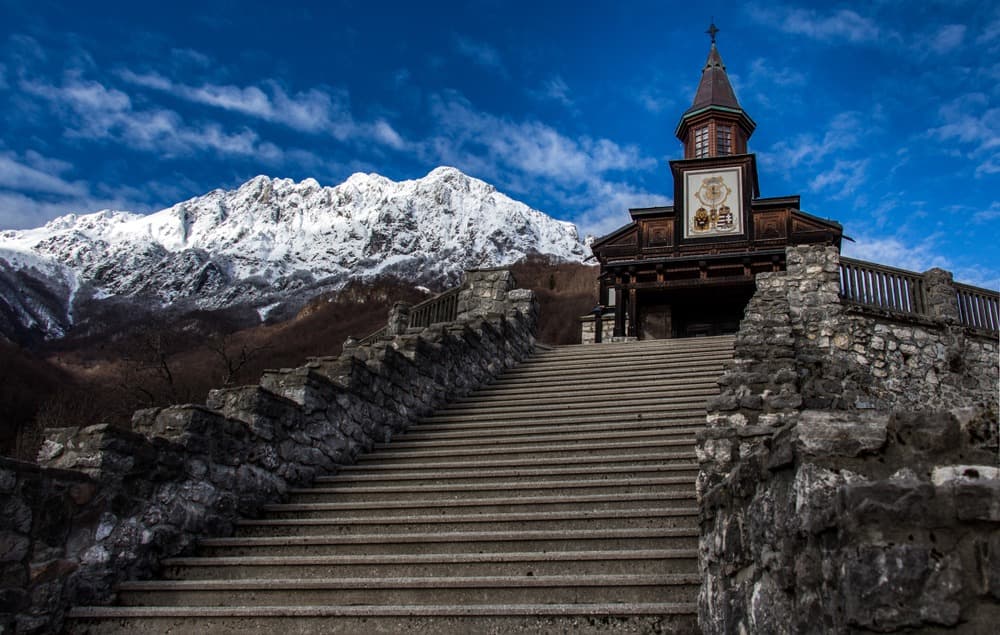
The Church of the Holy Spirit of Javorca is a wooden memorial built in 1916 by Austro-Hungarian soldiers in tribute to their comrades who fell on the Isonzo front. Perched on the Javorca hilltop at 571 meters above sea level, overlooking the Tolminka valley, it received the European Heritage label in 2018 from the European Commission.
Why visit Javorca
Javorca holds a singular place among World War I memorial sites. Built during the war itself by soldiers from more than twenty different nationalities, the church carries an explicit message of peace and reconciliation, expressed from the outset on its façade by the Latin word PAX. The site has earned three distinct recognitions: Slovenian monument of national importance (1999), sign of European cultural heritage (2007), and European Heritage label (2018).
The site's appeal also lies in its architectural rarity: it is one of the few surviving examples of Viennese Secession-inspired architecture applied to a military commemorative building, set in an isolated mountain setting within the Triglav National Park.
History of the memorial
The church was constructed between March 1 and November 1, 1916, in the midst of the Battle of the Isonzo, by Austro-Hungarian soldiers from the 3rd Mountain Brigade, a combat unit of the 15th Corps. It was designed by architect and lieutenant Remigius Geyling, who was mobilized on the front. The builders came primarily from Austria, Italy, and Hungary, and worked with materials available locally: stone from the rocky substratum for foundations and the lower section, and timber felled in the Soča valley for the upper part.
The Isonzo front (Soča in Slovenian), where Italian and Austro-Hungarian troops clashed between 1915 and 1917, left numerous traces in the region: trenches, caves, military cemeteries, and commemorative monuments. Javorca today forms part of the Peace March, a route connecting the Alps to the Adriatic Sea following these vestiges.
The building has undergone several restoration campaigns: in 1934 by Italian military units then present in the region, and subsequently in 1980, 2005, and 2016, following earthquakes and water damage. The centennial of its construction was celebrated in 2016.
What to see on the site
The exterior
The outer walls display frescoes of the coats of arms of 20 countries that composed the Austro-Hungarian monarchy, supplemented by those of Rijeka and Trieste. Above the entrance are a sundial, the coats of arms of Austria and Hungary linked to those of the Habsburgs, and the inscription PAX.
The interior
The interior space is organized in three naves and plays with four dominant colors: blue, black, white, and gold. The design follows the concept of Gesamtkunstwerk (total work of art) characteristic of Viennese Secession. The wooden elements of the altar were sculpted by Anton Perathoner, a master craftsman from South Tyrol originally from St. Ulrich / Ortisei.
Along the naves, oak panels bear the names branded by iron of 2,565 Austro-Hungarian soldiers who fell on the front, representing units of different nationalities, religions, and languages.
Practical information
- Duration of visit: allow 30 to 45 minutes on site, excluding access time.
- Admission: modest contribution; cash payment preferred.
- Accessibility: the site is not suitable for people with reduced mobility (gravel road, uphill path).
- Equipment: closed-toe shoes, warm clothing (the church is not heated).
When to visit
The visiting season runs primarily from late spring to early autumn. The access road, a gravel mountain track, may be impassable in winter and early spring due to snow or ice. June through September offer the most stable conditions, with July and August experiencing higher visitor numbers. For a quieter atmosphere, opt for early morning or late afternoon visits.
How to get there
The starting point is the town of Tolmin, in the Soča valley. Signs indicating Javorca are posted in central Tolmin at the traffic light intersection. Follow them to the village of Zatolmin.
From Zatolmin, there remains approximately 8 km of narrow gravel road, accessible by car (15 to 20 minutes depending on conditions). A parking area is provided below the site. From there, allow 15 to 20 minutes of uphill walking on a paved road to reach the Church of the Holy Spirit.
Nearby attractions
The Tolmin region and Soča valley are home to numerous natural and historical sites. The Triglav National Park covers most of the surrounding massif, with its gorges, trails, and mountain lakes. Further north, the lakes region offers two major highlights: Bled Castle and Bled Island, on the lake of the same name. To extend your journey, the capital is just two hours' drive away, with iconic sites such as Ljubljana Castle and the Dragon Bridge.
Frequently asked questions
Frequently asked questions
On Javorca hilltop, at 571 meters above sea level, overlooking the Polog plateau and the Tolminka riverbed, approximately 8 km from the village of Zatolmin (Tolmin municipality, western Slovenia).
No. The road from Zatolmin is a narrow gravel track, barely passable in winter. The favorable season extends from late spring to autumn.
Allow approximately 30 to 45 minutes on site, to which you must add the drive time from Tolmin (about 30 minutes) and 15 to 20 minutes of walking from the parking area.
Built by soldiers from across the Austro-Hungarian monarchy, it carries an explicit message of peace and reconciliation. It received the sign of European cultural heritage in 2007 and the European Heritage label awarded by the European Commission in 2018.
The oak panels inside bear the iron-branded names of 2,565 Austro-Hungarian soldiers who fell on the Isonzo front between 1915 and 1917.
Plan your trip
Javorca integrates naturally into an itinerary combining the Soča valley, Triglav Park, and the Alpine lakes region. For a tailor-made journey blending heritage, hiking, and nature, explore our Slovenia travel packages.
Nearby
Interested in this visit?
We can include it in your personalised itinerary.