Piazza Unità d'Italia
Piazza Unità d'Italia
In Trieste, Piazza Unità d'Italia is one of Europe's largest public squares open to the sea. History, palaces, and visiting tips.
On the waterfront of Trieste, Italy, Piazza Unità d'Italia opens directly onto the Gulf of Trieste. Bordered on three sides by administrative palaces and on the fourth by the Adriatic Sea, it is regularly presented as one of Europe's largest public squares open to the sea. Though Italian, its immediate proximity to the Slovénie border makes it a logical stop for travelers combining a Slovénie stay with a Trieste excursion.
Why Visit Piazza Unità d'Italia
The square brings together in a single space Trieste's administrative history under the Habsburgs, its annexation to Italy in the twentieth century, and its maritime openness. Its horseshoe configuration, enclosed by eclectic palaces of Viennese inspiration and open to the Adriatic, makes it one of the most recognizable urban landmarks in northeastern Italy.
- A coherent architectural ensemble from the eighteenth to early twentieth century.
- Direct access to the seafront promenade (Molo Audace).
- Strong historical significance, from Austrian Baroque to the 1938 fascist speeches.
- A vibrant square, animated in the evenings and during municipal events.
History of the Square
The space has borne several successive names. It was first called Piazza San Pietro, named after a church that stood there, then Piazza Grande, a name still used locally. In 1918, upon Trieste's annexation to the Italian kingdom, the square became Piazza Unità. Following the dissolution of the Free Territory of Trieste and the city's reintegration into Italy in 1955, it took its current name of Piazza Unità d'Italia.
On September 18, 1938, Mussolini delivered a speech from the central balcony of city hall announcing the implementation of fascist racial laws in Italy — an episode that permanently anchored the square in national memory. Its current appearance results from a redesign conducted between 2001 and 2005, which unified the ground surface, eliminated automobile traffic, and restored the perspective toward the sea.
What to See Here
City Hall and the Bell Tower
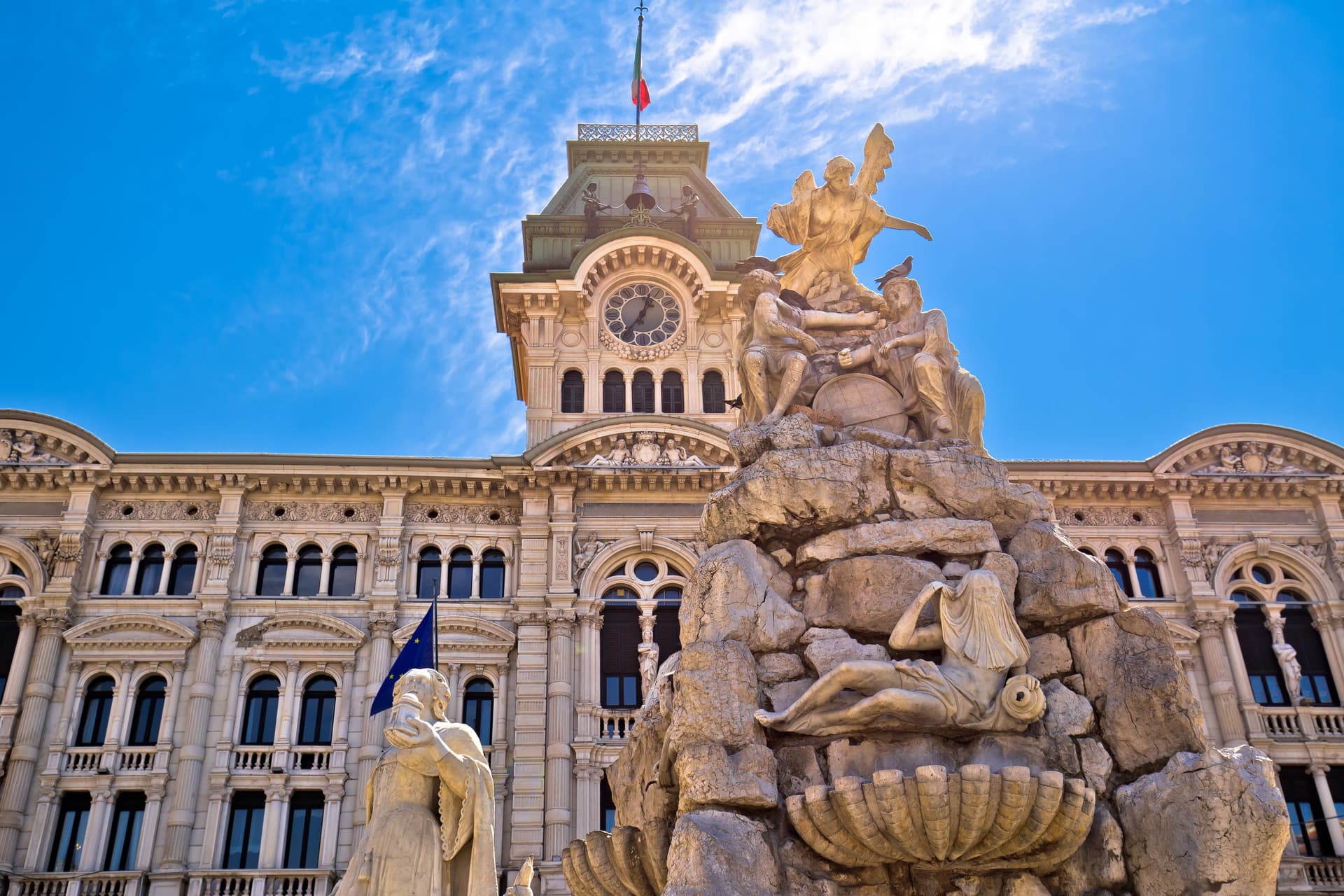
The municipal palace occupies the eastern side of the square, facing the sea. It is topped by the torre campanaria, fitted with two bronze jacquemarts representing Moors, nicknamed Micheze and Jacheze (Michael and James). Since 1876, they have struck the quarter hours on the municipal bell using a halberd, the city's emblem. The automatons visible today are copies; the originals are kept in the city museum.
The Austrian Lieutenant's Palace
Built in 1764 on the orders of Maria Theresa of Austria after plans by Giovanni Fusconi, this palace testifies to the Habsburg period. Its facade is adorned with mosaics reproducing the coat of arms of the House of Savoy, added after the annexation to Italy. It now houses the prefecture.
The Fountain of Four Continents
Situated facing city hall, the Fontana dei Quattro Continenti is crowned with a statue of an angel with outstretched arms symbolizing Trieste. Four allegorical figures represent the continents recognized in the eighteenth century: Europe, Asia, Africa, and America. The composition is completed by cotton bales and ropes, an allusion to the city's commercial and port vocation.
The Palazzo del Governo
Built between 1901 and 1905 by Viennese architect Emil Artmann, this palace exemplifies Viennese historical eclecticism. Its upper portion is clad in Murano glass mosaics, its lower portion in white stone. It houses the Government Commission for the Friuli Venezia Giulia region and the Trieste prefecture (UTG). The interior opens only on the occasion of special events.
The Lloyd Triestino Palace
Designed by architect Heinrich von Ferstel, this palace had its cornerstone laid on December 6, 1880 and was completed in 1883. Former seat of the Lloyd Triestino di Navigazione shipping company, it has been the headquarters of the Friuli Venezia Giulia regional council presidency since 1991. Its main entrance faces the square, but the building also opens onto via dell'Orologio and the Riva del Mandracchio.
Practical Information
- Access: the square is entirely pedestrian and open to all, day and night.
- Visit duration: allow 30 minutes for a tour of the square, 1 to 2 hours if you extend toward Molo Audace and Borgo Teresiano.
- Guided tours: Trieste's tourist office regularly offers thematic tours of the square and its palaces.
- Official buildings: the prefecture and Lloyd Palace can only be visited during special events (Heritage Days, exceptional openings).
When to Go
The square can be visited year-round. Spring (April–June) and early autumn (September–October) offer pleasant temperatures and favorable light for photographing the facades. In summer, visitor numbers are higher, especially toward evening. In winter, the bora, Trieste's characteristic wind, can blow forcefully; bring windproof clothing. Year-end illuminations transform the esplanade and are particularly appreciated.
How to Get There
Piazza Unità d'Italia is located in central Trieste, about ten minutes' walk from the main railway station. Several urban bus lines serve the immediate vicinity of the square. From Slovénie, Trieste is accessible by car from Ljubljana in approximately 1.5 hours, and from Koper or Piran in less than an hour. Bus connections also link the main Slovénie coastal towns to Trieste.
Nearby Attractions
The square is part of an urban route that includes Molo Audace, the Borgo Teresiano canal, and the San Giusto hill with its cathedral and castle. To extend into Slovénie, several sites are within day-trip reach:
- The Dragon Bridge in Ljubljana, emblem of the Slovénie capital.
- Ptuj Castle, in Slovénie's oldest town.
- The Rakov Škocjan park, for a contrast with Slovénie's karst landscape.
- The Pokljuka Plateau, in the Julian Alps.
Frequently Asked Questions
Frequently asked questions
The square is located in Trieste, Italy, in the Friuli Venezia Giulia region. However, it appears in many Slovénie itineraries due to the immediate proximity of the border and the cultural integration of the area.
The name Unità d'Italia was adopted after Trieste's final annexation to Italy in 1955. The square had previously been called Piazza San Pietro, then Piazza Grande, then Piazza Unità from 1918 onward.
Most buildings are administrative seats (prefecture, regional council) and open only on special occasions. City hall occasionally opens its grand halls.
30 minutes are enough for a tour of the square and to observe the facades. Allow 1 to 2 hours to include Molo Audace, the neighboring canal, and a terrace break.
These are the Trieste nicknames for the two Moor-shaped jacquemarts that have struck the quarter hours on the bell tower of city hall's bell tower since 1876.
Extend Your Stay in Slovénie
A trip to Trieste fits naturally into an itinerary covering the Slovénie coast and its karst hinterland. To prepare your stay, consult our suggestions for custom travel to Slovénie.
Interested in this visit?
We can include it in your personalised itinerary.