Dragon Bridge
Dragon Bridge
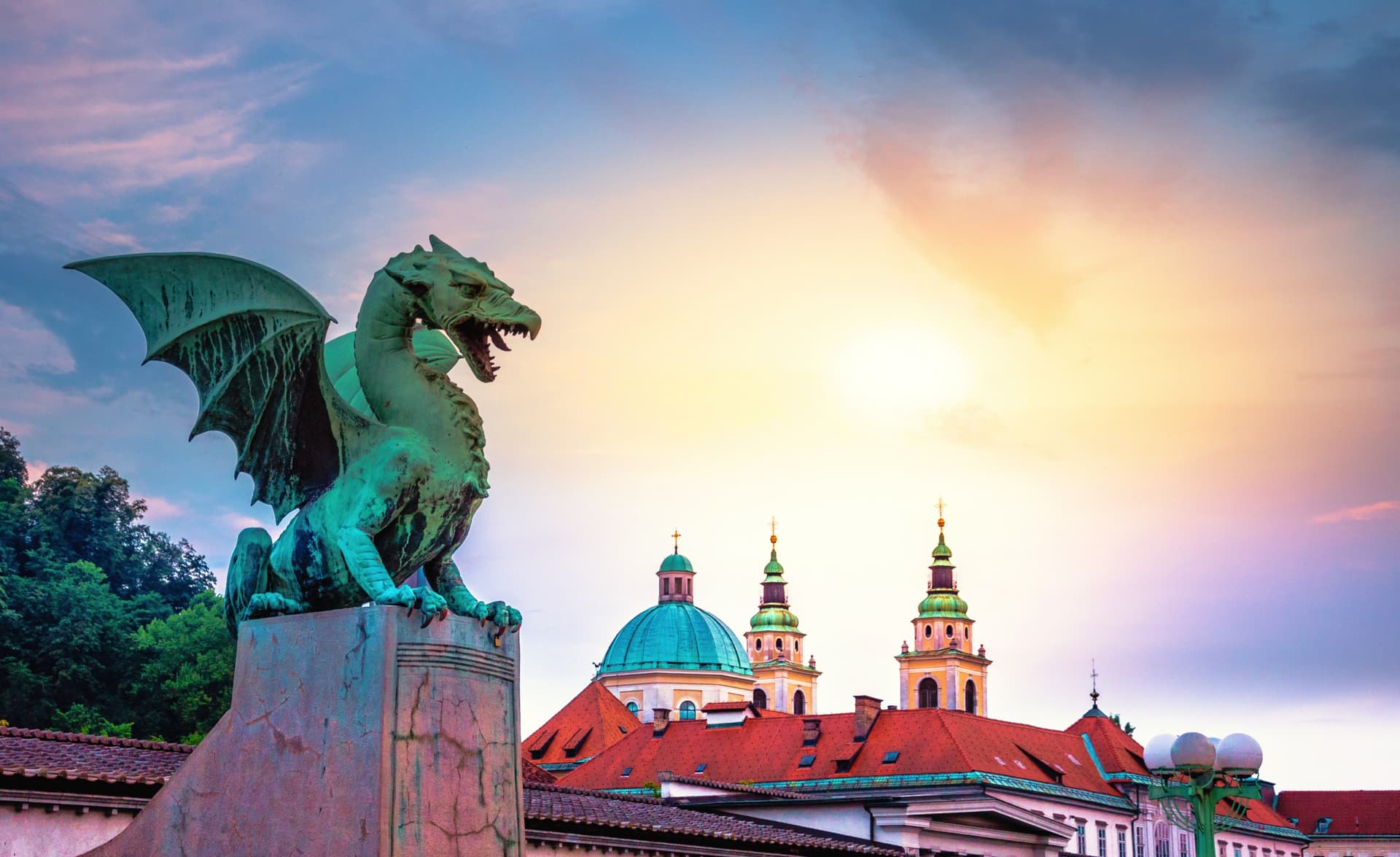
Built in 1901 in Ljubljana, the Dragon Bridge combines Josef Melan's reinforced concrete engineering with Jurij Zaninović's Art Nouveau decoration, marked by its four copper dragons.
The Dragon Bridge (Zmajski most in Slovenian) spans the Ljubljanica in the heart of Ljubljana, just steps from the central market. Recognizable by its four copper dragons standing at its ends, it marks the entrance of Vienna Secession style to Slovenia and is one of Europe's first reinforced concrete bridges.
Why visit the Dragon Bridge
The Dragon Bridge condenses multiple layers of meaning in a single structure: a 1901 engineering feat (when reinforced concrete was still in its infancy), an architectural signature of Viennese Art Nouveau, and an urban symbol—the dragon, Ljubljana's heraldic animal. Crossing it takes just minutes, but it fits naturally into a riverside walk between Plečnik's bridges and the covered market. It's as much a practical landmark as an object of fascination for those interested in early 20th-century architecture.
History and legend
The current structure was built between 1900 and 1901 to replace a wooden bridge from 1819, severely damaged by the 1895 earthquake that reshaped much of the city. The municipality, constrained by the high cost of stone reconstruction, opted for a more modern solution: a reinforced concrete bridge.
The design involved two complementary figures. Austrian engineer Josef Melan, a recognized specialist in reinforced concrete structures, provided the patented structural system bearing his name (a steel frame embedded in concrete). Dalmatian architect Jurij Zaninović, a student of Vienna's Otto Wagner, created the architectural treatment: concrete cladding, balustrades, lampposts and copper sheet dragon statues. The Art Nouveau character of the bridge owes entirely to him.
At its inauguration in 1901, the bridge was named Emperor Francis Joseph I Jubilee Bridge, honoring the Austro-Hungarian emperor—Ljubljana was then part of the empire. The official name quickly gave way to common usage: because of the four dragons watching from its corners, people simply called it the Dragon Bridge.
Why a dragon? A Greek legend connects the creature to the city: Jason and the Argonauts, returning after stealing the Golden Fleece, supposedly encountered a monster in a swamp near Ljubljana. The dragon became the city's heraldic emblem, appearing on its coat of arms.
What to see on site
The bridge's appeal lies in both its overall design and the details of its decoration:
- The four copper dragons at its ends, recognized as Ljubljana's most iconic image.
- The structure itself: a reinforced concrete arch using the Melan system, one of the first such realizations in Europe.
- The balustrades, lampposts and Art Nouveau motifs designed by Zaninović, in Vienna Secession vocabulary.
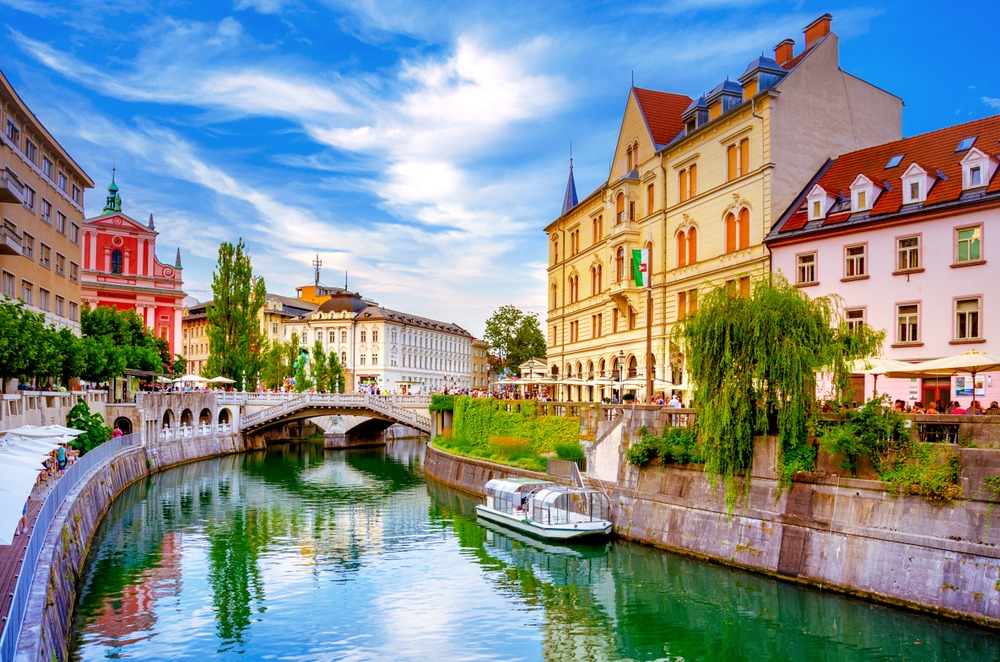
- Views of the Ljubljanica and Plečnik's central market on the south side.
It's worth descending to the landscaped banks to appreciate the sculptures: the dragon volumes and arch elegance are best grasped from river level.
Practical information
The Dragon Bridge is a public road open permanently and freely accessible to pedestrians. It sits northeast of Vodnik Square, between Kopitarjeva ulica to the south (central market side) and Resljeva cesta to the north (Hiša eksperimentov, the House of Experiments side).
- Access: on foot from the historic center, allow 5 to 10 minutes from Prešeren Square.
- Visit duration: 15 to 30 minutes to walk around, observe the dragons and descend to the quays.
- Best time: early morning or late afternoon for light on the patinated copper sculptures.
- Admission: free.
The bridge is open to traffic: be cautious when photographing from the roadway; sidewalks are provided on each side.
Nearby attractions
The bridge fits into a dense urban walk. In the immediate vicinity:
- Plečnik's central market and Vodnik Square, just to the south.
- The Butchers' Bridge (Mesarski most), known for its padlocks and sculptures by Jakov Brdar.
- The Triple Bridge (Tromostovje) and Prešeren Square, 5 minutes' walk along the river.
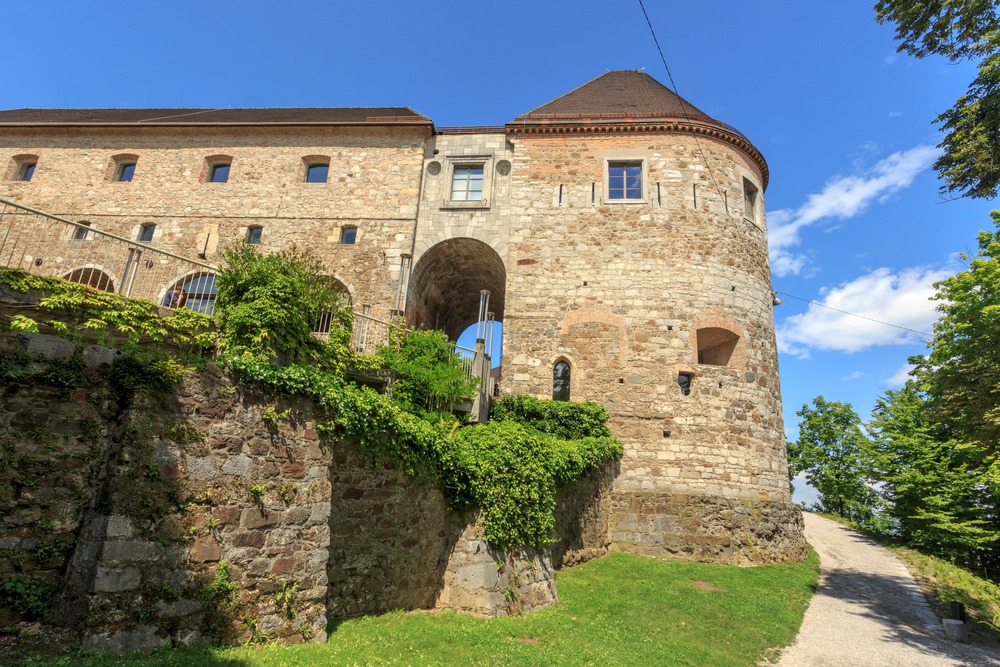
- Ljubljana Castle, accessible by funicular from the old town.
Expanding further, Slovenia offers other heritage stops such as Ptuj Castle, or nature escapes around the Pokljuka Plateau in the Julian Alps.
Planning your visit
The Dragon Bridge is a brief but significant milestone in a Ljubljana stay, best combined with exploring the historic center and castle. To fit this stop into a complete itinerary, consult our tailor-made trips to Slovenia.
Interested in this visit?
We can include it in your personalised itinerary.